
Conflicts…I’ve had a few (bazillion)
Confessions of a recovering hothead

Two days after attending a mindfulness conference at UC Berkeley’s Greater Good Science Center, I found myself storming out of a meeting. So much for inner peace.
Here’s what happened: my data analytics team had created a tool that could make life easier for a partner team—if they did a bit of upfront work. When they didn’t, my frustration built. My colleague Mark was patiently trying to understand the situation, “I just want to try and understand…” That’s when I cut him off with: “I want to understand why your team isn’t doing their job!” Then I marched out of the room.
Yes. Two days after a daylong mindfulness retreat.

Later, after apologies and repair, we managed to laugh: “The conference didn’t work for Robin. She’s demanding a refund.” Humor helped. Still, I look back on that moment with regret. I suspect at least one person in that room never fully trusted me again.
It may seem strange that I—an organizational psychologist committed to making business more human—would have such a “brat attack” at work. While not a pattern, I’ve had to work at managing my fiery streak (hello, Aries sun, Enneagram 8). And here’s the thing: most conflict advice hasn’t always spoken to me. It often assumes you’d rather avoid conflict, or it suggests strategies that feel inauthentic.
“So what I hear you saying right now is…”
OMG. Kill. Me.
These type of rote statements make my skin crawl.
So how do we approach conflict in a way that feels honest, grounded, and reparative? When conflict arises—and it will—I want it to clarify perspectives and deepen relationships. My long-term connections matter too much to risk with reactive behavior. I want the steady self-confidence that comes from standing on solid emotional ground.
I want to act my age, not my shoe size, as Prince advised.

Self-regulation and emotional maturity is vastly important not just to sustaining healthy work relationships but ALL relationships. And when it seems that the earth is spinning off its axis with conflict, let peace begin with me. Here are 3 practices that help me cool down.
Get on the balcony
I’ve written about this concept before: I’ll See you on the Balcony. When you feel triggered, imagine stepping off the stage and onto the balcony, looking down at the situation with perspective. From the balcony, you might ask yourself:
What is really going on here?
Why am I getting so riled up about this?
Is one of my values being violated? Is a boundary getting crossed?
Is this really worth it? Will this issue matter in an hour, a week, a month, or a year?
Is this issue even my business?
I use “balcony” as a handy mnemonic and just say it to myself when I start to feel activated.
Breathe
The simple act of taking a deep breath is like hitting a reset button for your nervous system. Take. A. Breath. Better yet, try box breathing:

A deep breath is like an antidote to amygdala hijack. Even two rounds of box breathing can calm your nervous system and bring your brain back online. When you’re activated, remind yourself to breathe - the deeper the better. (Pro tip: don’t tell other people to breathe in the heat of the moment—it rarely goes over well. Ask me how I know.)
Ground in your Values
Values are your bedrock. Tools like the Good Project’s values sort exercise can help you identify yours. But that is just the first step.
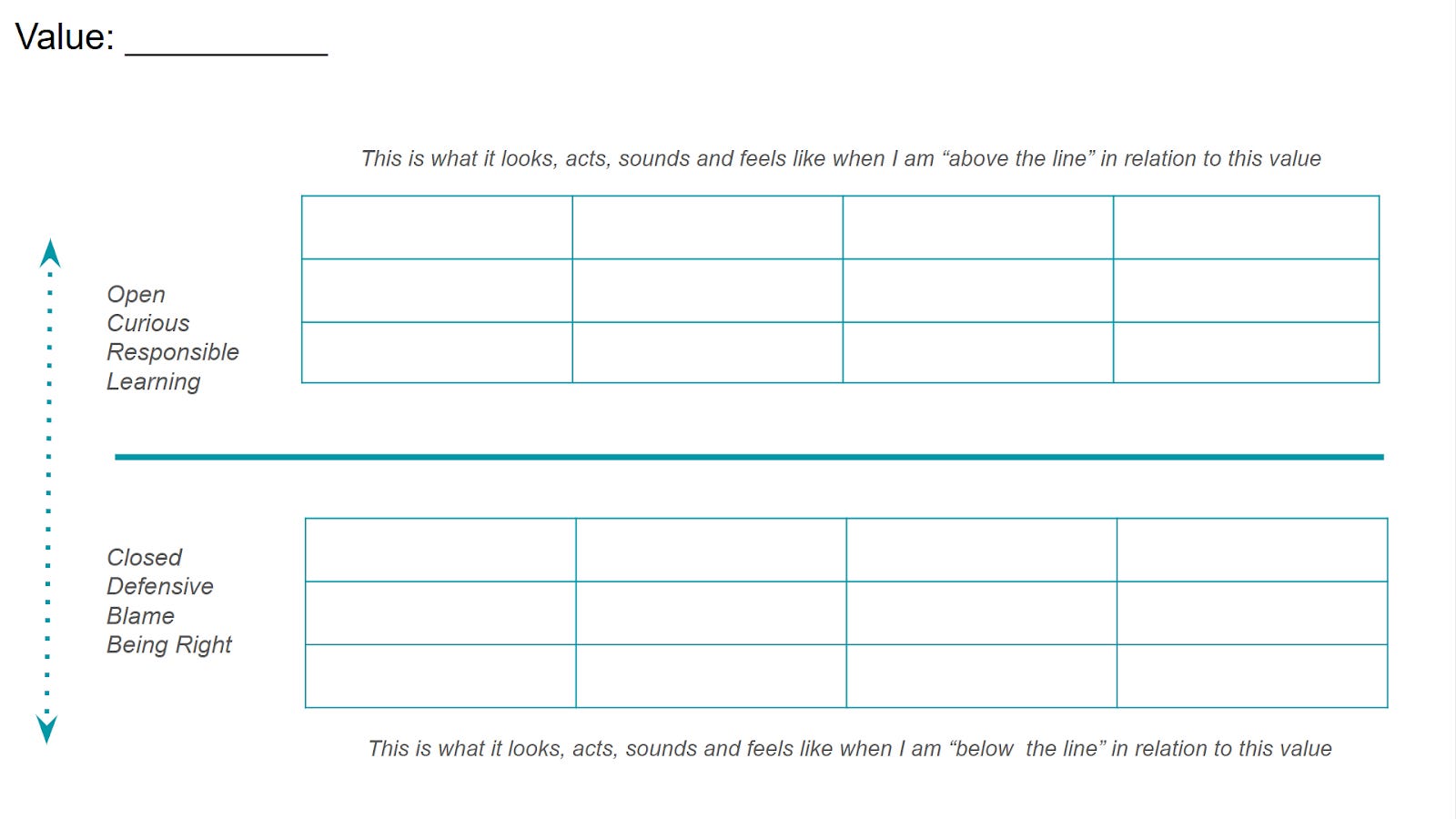
The next step is noticing the behaviors that show up when you’re aligned with those values—and when you’re not. For example:
Aligned with my value of respect: I listen and ask questions.
Out of alignment: I interrupt and push.
I offer this template for this very simple but powerful tool. This “above the line / below the line” awareness creates solid footing instead of leaving you at the mercy of reactivity.
Radical Responsibility + Self Compassion
When anger has flared and shame creeps in after the fact, the work is to step out of blame and shame and into accountability and compassion. Brené Brown emphasizes that interpersonal repair requires vulnerability — admitting the misstep, apologizing cleanly without excuses, and being willing to change
Accountability begins with asking, “What is my part in this conflict?” That might require deeper reflection about one’s own reactivity and triggers. What value was compromised? What boundary was crossed?
And then with radical honesty make amends to those you harmed. Here are some best practices:
Use “I” statements as much as possible and avoid “you” statements
Never follow an apology with the word “but…”
Ask what repair looks like for the other person
Use non-violent communication process when you feel another has wronged you:
State the behavior with no interpretation - “You have shown up late to our last three meetings.”
Share the impact that behavior had on you - “My time is as equally valuable as yours and I feel that you don’t respect my time when you are late.”
Make a clear request - “I would like you to prioritize being on time for our meetings.”
We’re only human

I’m only human
Of flesh and blood, I’m made
Human
Born to make mistakes
Kristin Neff reminds us that anger is part of being human, and the self-compassion stance is to notice our own pain and hurt, hold it with kindness, and remember we’re not alone in losing our cool.
The path forward after conflict is a blend of self awareness, honesty, and courageous repair. That’s the way back to trust and integrity. And now that you know better, you can do better!
What is your personal development learning edge and how are you developing greater personal and relational mastery in your life? Share here or drop me a note!

Leadership Development starts with the self. Ready to take accountability and make progress? I coach individuals and intact teams. Feel free to set up a complimentary consultation and we can assess if my approach is a good fit for your needs.
Please subscribe and share this article. The Soft Stuff is the Hard Stuff is always free.