
Designing the Shift
A Change Canvas You Can Use

“The only way to make sense out of change is to plunge into it, move with it, and join the dance.” — Alan Watts
Organizational change is hard.1
Not intellectually hard.
Emotionally hard.
Relationally hard.
Systemically hard.
Most teams can describe where they are. Many can articulate where they’d like to go. The part that gets murky is the space in between.
That middle zone is where culture either shifts or retrenches.
This month, I’m sharing a tool I designed for a recent client workshop on employee engagement: The Ubuntu Culture Company Change Canvas. It helps teams think clearly and deeply together about how change actually unfolds.
The Thinking Behind the Canvas
The structure is loosely inspired by Kurt Lewin’s early change model.
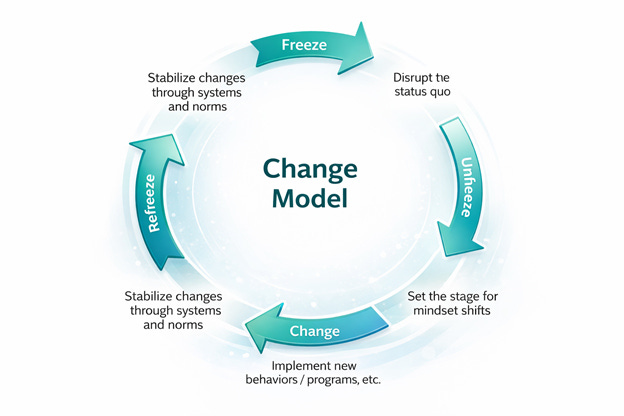
I’ve always appreciated the simplicity of Unfreeze → Change → Refreeze.
Before something new can take root, something old has to loosen. Eventually, new behaviors solidify once again into “the way we do things around here.”
In practice, though, organizations tend to rush from vision to action. The unfreezing — the preparation, the conversations, the small steps that build readiness — doesn’t get the same attention.
That’s the gap this canvas is designed to address.
TODAY → SHIFT → TOMORROW
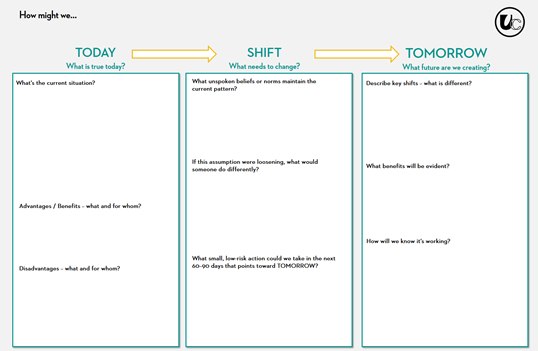
The canvas moves horizontally across three phases:
TODAY
What is the lived reality right now?
What patterns reinforce it?
Where are people grinding?
What are we tolerating?
This part requires honesty and the safety to really name what is actually going on.
TOMORROW
If things were meaningfully better, what would be different?
How would decisions feel?
How would collaboration work?
What would employees notice?
Specificity matters here. Vague aspirations don’t move systems, behaviors and tangible outcomes do.
SHIFT
What has to happen between TODAY and TOMORROW? This is the liminal space where we identify:
What assumptions and beliefs need to loosen?
Who needs to be engaged, influenced, bought in?
What conversations need to take place that haven’t happened yet?
What small moves build momentum?
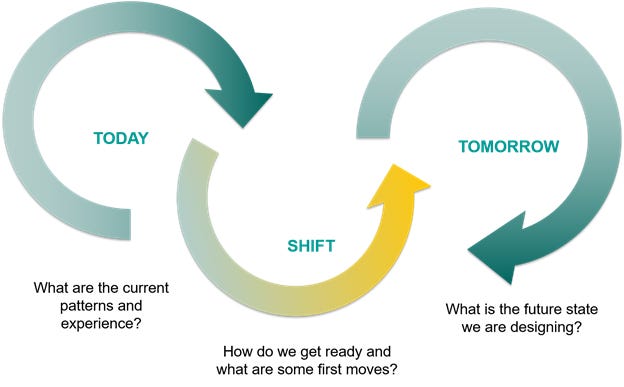
SHIFT is where willingness and resistance both show up. It’s also where thoughtful planning, facilitation, and storytelling make the biggest difference.
Why I Add Visualization
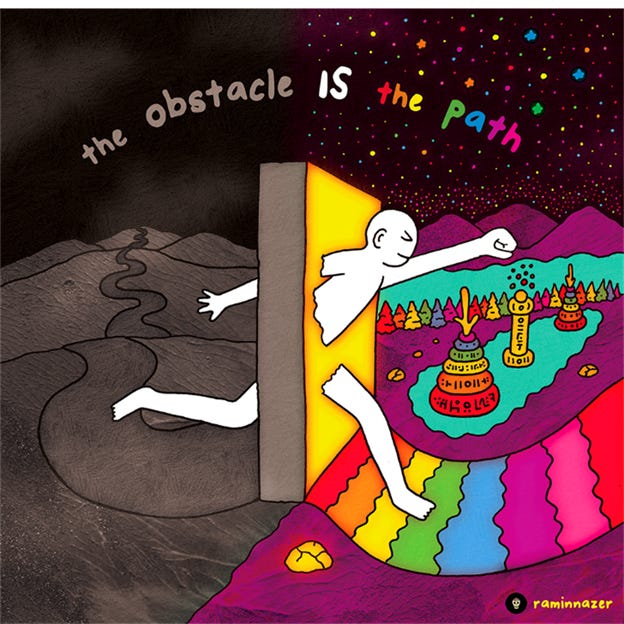
After teams complete the canvas, I ask them to translate it into a simple storyboard — a comic strip of the journey.
There is always groaning.
“I can’t draw.”
That’s fine. Circles and stick figures are enough.
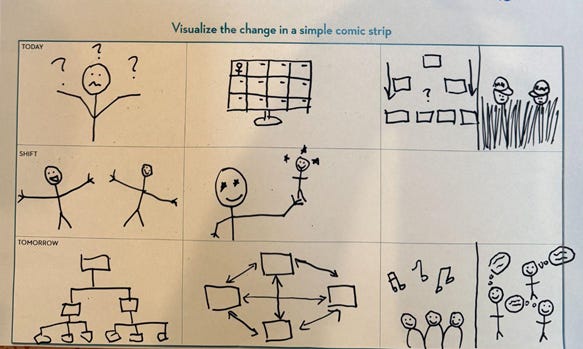
When ideas move from abstract discussion into visual form, thinking evolves. People see gaps in logic. They notice missing steps. They spot unrealistic leaps. The conversation deepens beyond “today sucks and tomorrow will be amazing” to “how will we actually traverse this chasm and succeed in this whole journey?”
Research on visual cognition consistently shows that humans detect relationships more easily when information is spatially arranged. We remember it better, too. Drawing makes thinking tangible.
It doesn’t need to be beautiful. Like a prototype, a visual artifact gives people who weren’t there something to respond to, add to, and engage with. Designer and fellow collaborator, Uday Gajendar, refers to visual concepts as “anchor objects” — artifacts that help to ground the conversation.
The Groan Zone
In a very recent client workshop, I warned the group:
“This is the workshop equivalent of the dark night of the soul.”
It was the second of four sessions, and they were being asked to dig beneath surface-level ideas. They had to examine the assumptions reinforcing their current culture and identify small, credible shifts toward something better.
It got uncomfortable.
That discomfort has a name: The Groan Zone — the messy space between divergent thinking and clarity. It’s a normal part of collective sensemaking. If you move through it thoughtfully, insight emerges and breakthroughs happen. If you avoid it, you get superficial change.
The canvas gives structure during that dark night stretch and coalesces the group just enough to do the deeper work.
From Artifact to Alignment
Once the storyboard is created, it becomes an artifact for feedback and iteration.
It gives people who weren’t in the room something concrete to respond to. Instead of debating abstractions, they react to visible steps in a journey.
“This leap feels too big.”
“We’re missing socialization and buy-in here.”
“This assumes trust we haven’t built yet.”
“We have to say this differently or people will get defensive.”
The voices included is widened making the change process gain momentum.
Designing Change
Change does not happen because we want it or, even, declare it. It happens because we design the conditions that make it possible.
The Change Canvas helps teams:
Clarify current reality
Envision a credible future
Design the transition intentionally
Create visible artifacts for feedback and refinement
If you’re working on culture, engagement, strategic alignment, or leadership development and your team feels stuck between “where we are” and “where we want to be,” it may be time to spend more attention on the SHIFT.
If you’d like to explore a challenge using this canvas, reach out. I’m always happy to talk through real situations.
Sometimes drawing it out is exactly what makes it move.

Please comment, heart, and share - it helps people find me and the ideas I share on The Soft Stuff is the Hard Stuff.
Seventy percent of change efforts fail and somewhere around 40,000 organizational change books have been published.
Such inspiring work!