
Employee Experience Frameworks
Designing for Human Flourishing in the Workplace

Humans are social animals wired for safety and belonging—and when those needs feel threatened, our nervous system does what it evolved to do: protect us.
Neuroscience makes plain that stress - especially when our emotional or physical safety feels at risk - literally shrinks our brain’s capacity. This is often referred to as an “amygdala hijack”1 when the fight-flight part of our brain takes over and the only thing grabbing our attention is survival. That means that higher order functioning goes out the window. You’ve seen the result at work. Curiosity shrinks. Collaboration stalls. People stop raising their hands and start guarding their turf - or leaving altogether.
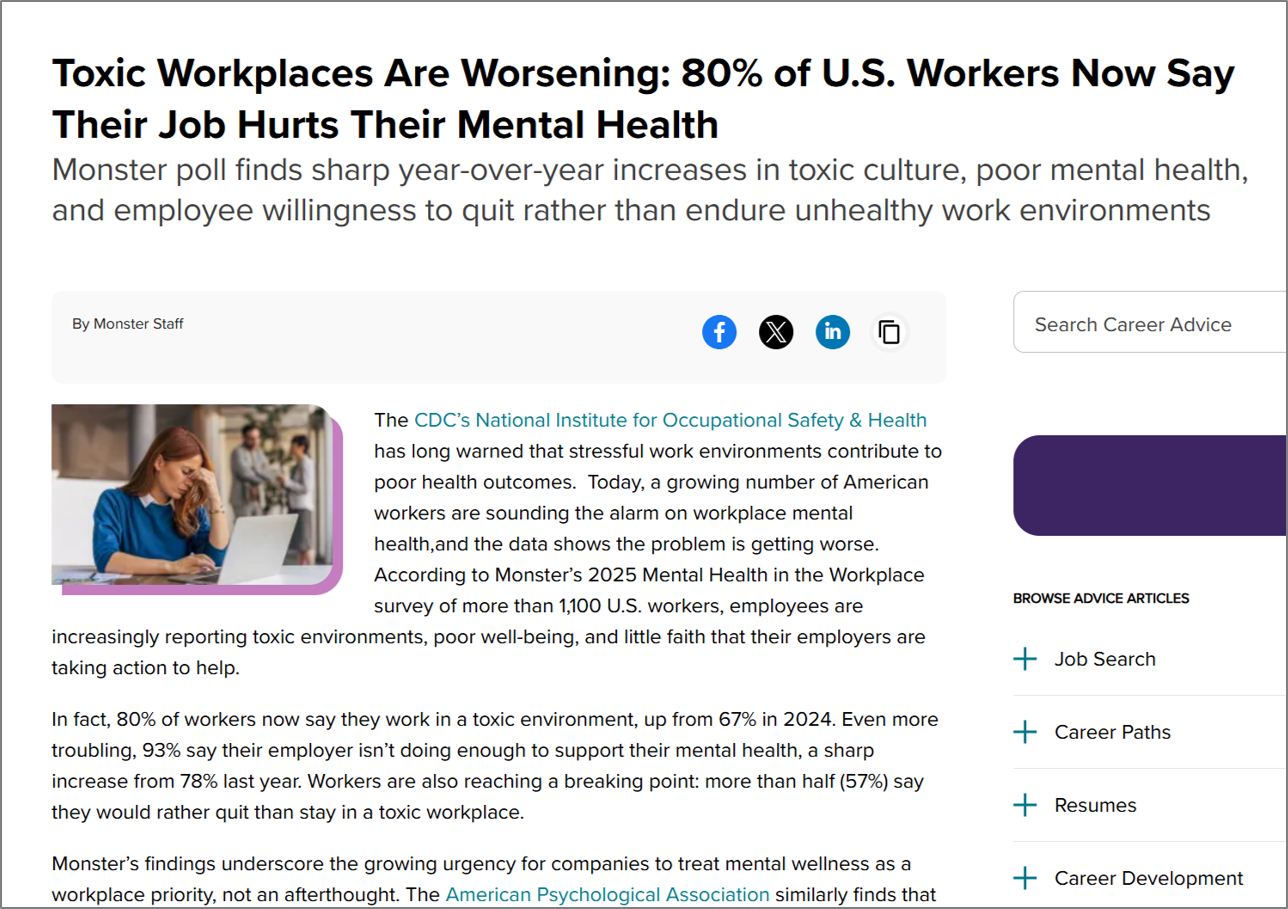
I don’t know any organization leader who would want employees with most of their brains shut down due to stress and yet an alarming 80% of U.S. Workers report that their mental health suffers at work. Ninety-three percent say their employer is not doing enough to support a healthy work environment, and 80% (up from 67% in 2024) characterize their organization as “toxic.” That’s an operational risk, not just a moral one. A stressful, toxic, or unsupported work experience costs organizations the very capacities they most need to innovate.
If you want employees who are engaged and happy, creating a culture of care and high engagement must become a set of core capabilities that your organization designs, operationalizes, and measures. That’s where an employee experience framework can really add value.
What an Employee Experience Framework Is (and Isn’t)
An employee experience framework connects two things:
What it feels like to work here, and
How we intentionally design and manage that experience.
It’s not your org chart, not your benefits menu, and not a poster of values. Yet it translates values into the structures, practices, systems, and routines people actually live every day.
In 2022, the U.S. Office of the Surgeon General released a groundbreaking report: The Framework for Workplace Mental Health and Well-Being. It offers a clear, durable model for workplace mental health and well-being, developed through employee listening across industries and expert input from economists, sociologists, public health leaders, organizational psychologists, and labor voices. It proposed that workplaces can become “engines of mental health and well-being” by focusing on five essential elements:
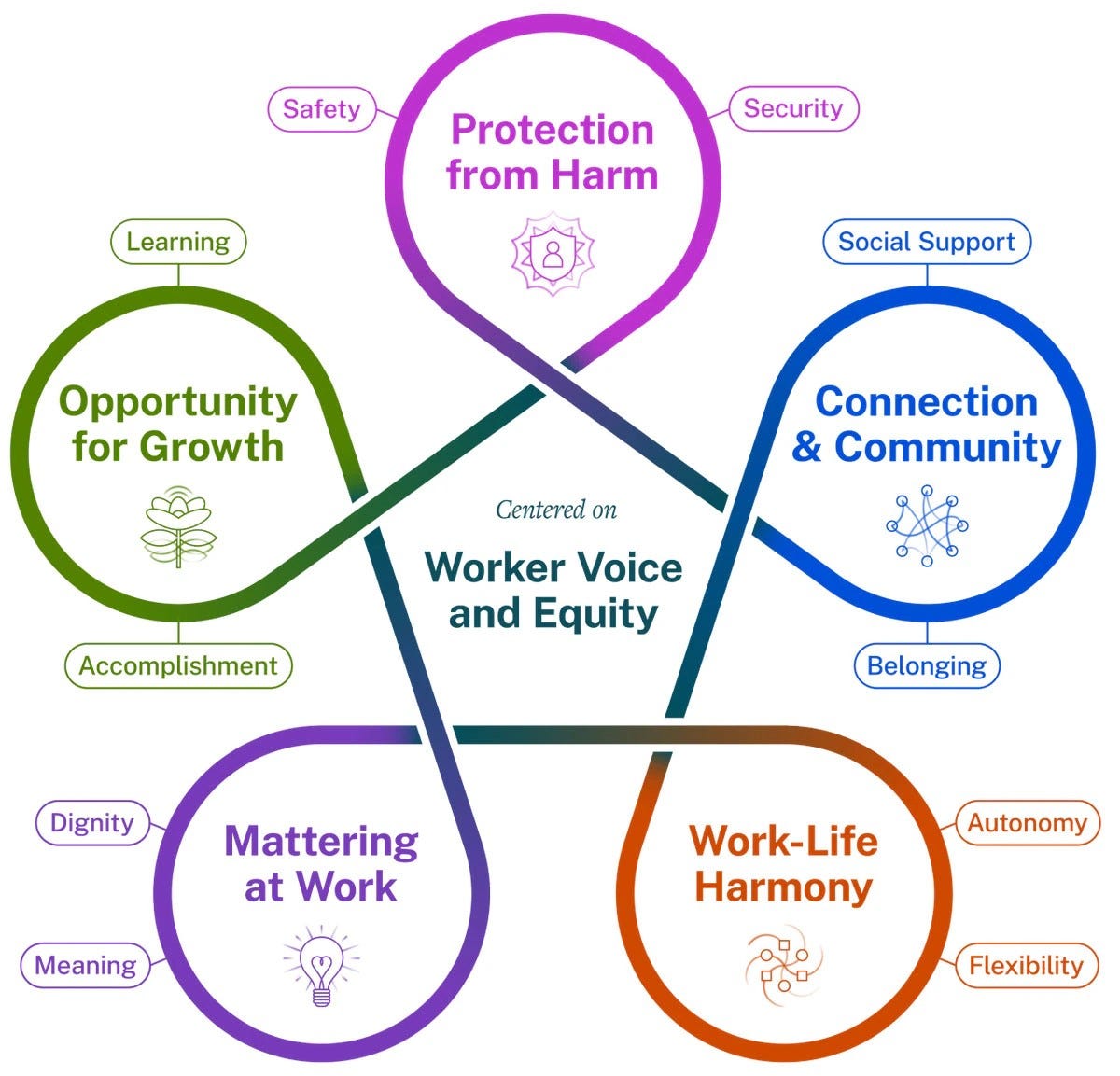
I first learned about this work through workplace designer Ashleigh Reeves, who helped lead the effort at HHS and now applies it inside Amazon. The attributes I value most in the model: it’s simple enough to remember and robust enough to matter. This framework also mirrors what organizational behavioral science and human-centric workplace design have taught us for decades: human thriving and business performance rise and fall together.
How to Use the Five Essentials in your Workplace
My approach is to treat any existing model as a sacrificial concept2 — a spark for inquiry co-design, and adaptation, not wholesale adoption. We can use the five essentials to guide discovery, to prototype better ways of working, and to measure what changes. Here’s a lightweight path I use with clients and teams.
1) Inspiration and Learning
Skim the framework report and whichever recommended resources grab you.
Turn each element into questions aimed at your organization that you can test over the next 30 days. For example, under “Connection & Community,” you might ask: where does connection already live, and where do handoffs break it?
Capture hypotheses to validate with employees.
2) Current-state Assessment
Make it safe to tell the truth by being transparent that the organization wants to understand employees’ current experience so that it can be improved.
Engage in employee listening across the organization.
Run a survey that contains questions on each of the essential elements of workplace wellbeing.
Pair qualitative stories and insights with quantitative signals and sizing.
A good listening system combines contextual sensemaking and insights with communication and action.
3) Future-state Vision
Host a short workshops to sketch “an ideal employee experience that fuels organizational success” one year out for each element.
Keep it visible and behavioral: meetings, rituals, artifacts, decision rights.
At the conclusion of the workshop, ask each participant to write down what this would feel like.
4) Diagnose and Design with Real Levers
Analyze the gap between current and ideal state.
Choose one or two high-leverage moments to redesign.
Map changes to the levers people actually feel: structure, processes, roles, tech tools, skills, and norms.
5) Make Learning Visible (Scorecard, not report card)
Create an Experience Scorecard with one or two indicators per element.
Usefulness matters more than frequency. I’ve seen annual engagement surveys and weekly pulses; daily pop-ups are too intrusive to recommend.
The goal is to spark curiosity and action: “Here’s what we heard; here’s what we’re trying next.”
Treat the scorecard as the other half of the listening feedback loop - we listen to employees and now we reflect as leaders. Communication combined with action is key: publish what changed so people see their fingerprints on the culture.
Tales from the Field
In my consulting work, I’ve used the Five Elements model as both diagnostic and design tool. One organization found that onboarding was a major friction point. We redesigned it through the lens of Connection and Community and established a practice of pairing every new hire with a “Best Friend at Work” who guided them through their first month, both technically and socially. The result wasn’t just happier employees; it was faster integration, stronger retention, and more cross-team collaboration.
Another team applied Mattering at Work to rethink recognition. Instead of annual awards, they built micro-recognition rituals - peer shoutouts in meetings, “gratitude rounds” in retrospectives, small symbols of appreciation visible to all. What mattered wasn’t the size of the reward, but the regular signal that people’s contributions were seen.
A Few Concrete Moves to Consider, Pilot, and Adapt
Connection & Community. If onboarding is brittle, assign every new hire a BF@W (Best Friend at Work) with explicit responsibilities: lunch in week one, “map of who matters” introductions, and a checklist to get access to tools and folders. Recognize the buddy role in performance conversations so it sustains and feels like real contribution, not “shadow” work.
Mattering & Recognition. Go beyond annual reviews. We know from research that recognition is not one-size-fits-all. Blend peer shout-outs in team meetings, spot bonuses, and growth privileges like conference slots or demo stages. Design for variety so recognition lands across personalities and preferences.
Work-Life Harmony. Ask teams to audit their recurring meetings and after-hours pings. Challenge them to discontinue two meetings. Considering adding “no-meeting” blocks to employee calendars for heads-down thinking and working.
Protection from Harm. Name three potential “dignity violations” in your current environment - e.g., blame-heavy postmortems, public shaming in meetings, ambiguous decision rights. Redesign one ritual to reduce threat cues and enhance dignity.
Growth & Development. Publish a simple capability checklist for the employees according to their function / role. Allow for self- and manager-ratings to guide coaching, development opportunities, and to calibrate on future growth. This turns “where do I stand?” into a shared alignment on a career path.
Your organization can also use journey moments to focus on by mapping the employee life cycle: join → onboard → contribute → grow → belong → evolve.3 Choose one moment each quarter and make it better end-to-end.
Building the Human Operating System
Where most organizations stumble to improve employee experience is in execution. They confuse perks for system design - like, launching a meditation app while leaving structural stressors intact. They treat “engagement surveys” like report cards rather than learning feedback loops and ongoing action.
An Employee Experience Framework bridges this gap. It’s the structured design of how the system functions for the people in it - it is the connective tissue linking what it feels like to work somewhere with how the organization actually runs.
As Steve Job pointed out, design isn’t about aesthetics, design also determines function and feeling. Intentional design of the employee experience allows organizations to shape, scale, and measure performance enabling conditions in their workforce and concretely translate values into the way work happens on a day-to-day basis.
The most effective leaders approach employee experience like any complex system: holistically, iteratively, and with data. Workplace wellbeing isn’t a program to deploy; it’s a living system to steward. When leaders treat employee experience as design, not decoration, they build cultures that learn faster, adapt better, and innovate more responsibly.
The soft stuff - safety, belonging, growth - isn’t soft at all. It’s the architecture of thriving at work.

Ready to redesign your employee experience? I can help you surface the hidden truths of your current workplace reality, uncover what’s blocking engagement, and design for measurable engagement improvement - the kind that fuels innovation and the bottom line.
If you found this post valuable, I would be grateful if you would do one of the following:
The “amygdala hijack” is a term coined by psychologist Daniel Goleman in his 1995 book Emotional Intelligence. It refers to an intense emotional reaction that’s out of proportion to the circumstance.
Fellow human-centered design expert and close friend, Suz Howard, introduced me to the term “sacrificial concept.” A sacrificial concept is something we use to spark conversation and thinking; it is a prototype, not a finished product. So even though I think the five essential elements for worker wellbeing are quite robust, there will be ample opportunity to adjust and customize these elements for your specific context. So look at this as a starting point for your inquiry.
These are just example phases, your organization should be customized to your context.
Robin, this is very rich content and so valuable. Thank you!